In power supply assurance for medical imaging equipment and data center infrastructure, voltage stability and electrical isolation are the primary concerns of buyers. Precision imaging devices such as MRI and CT impose strict requirements on voltage accuracy, leakage current and waveform quality. Data centers, on the other hand, face multiple challenges including harmonics from non-linear loads, utility voltage fluctuations and North American market access compliance. Shenzhen Xingkerong Technology Co., Ltd. (Brand: SINCRON), an industrial power manufacturer integrating R&D, production and after-sales service, has specialized in transformers, smart voltage stabilizers, variable frequency power supplies and UPS uninterruptible power supplies since its establishment in 2007, delivering systematic solutions for these application scenarios.
Medical Imaging Scenario: Maintenance-Free Operation and High Precision as Core Considerations
Scenarios such as medical imaging, communication base stations and auxiliary data center facilities generally operate with minimal allowance for shutdown. If voltage stabilizers rely on mechanical components like carbon brushes, periodic maintenance will become a heavy burden. To tackle this pain point, Xingkerong contactless smart voltage stabilizers (SCR/ASR) adopt thyristor stepped voltage regulation without mechanical wear, meeting the demands of unattended continuous operation. The product delivers ±1% output accuracy with a response time of approximately 20 ms. Independent voltage regulation for each phase maintains balanced three-phase output, which is especially critical for MRI, CT and other equipment sensitive to voltage accuracy and leakage current.
For power device selection, the contactless smart voltage stabilizer adopts SEMIKRON SCR thyristor modules from Germany. The modules feature consistent chips, strong surge withstand capability and long thermal cycle life. The modular package stabilizes commutation loops and heat dissipation paths, keeping parameter drift within a narrow range during long-term operation. In addition, the product integrates eight protection functions: overvoltage, undervoltage, overcurrent, overtemperature, phase loss, short circuit, lightning protection and time delay, equipped with audible and visual alarms. It automatically protects loads and itself under abnormal conditions and switches to mains bypass upon fault to avoid equipment downtime. The LCD touchscreen and parameter calibration function lower on-site operation and maintenance thresholds. Optional Modbus RS232/RS485 communication interfaces allow connection to energy management systems for remote monitoring.
Notably, apart from medical and precision instrument applications, Xingkerong also provides IGBT static voltage stabilizers (HIS) as a supplementary solution for small loads requiring fast response. Adopting IGBT inverter technology to deliver clean sinusoidal output, it achieves a response time of roughly 10 ms, the fastest among the three stabilizer types. Without carbon brushes or mechanical regulation structures, it generates less heat and enjoys a longer service life. It is suitable for laboratory standard sources, precision medical equipment, CNC machines and other scenarios with strict requirements on waveform quality and response speed.
Data Center Scenario: Balancing Isolation, Harmonic Suppression and North American Market Access
Data center power systems face more diversified challenges. On one hand, harmonics generated by non-linear loads including server power supplies, UPS units and variable-frequency air conditioners accumulate on neutral conductors, causing abnormal heating and accelerated insulation aging of ordinary transformers. Under heavy load, neutral current may even approach or exceed phase current. On the other hand, for North American projects, the National Electrical Code (NEC) requires electrical equipment to be accepted by the Authority Having Jurisdiction (AHJ). Most AHJs only recognize NRTL-listed equipment, and transformers without UL listing may be rejected for installation during acceptance inspection.
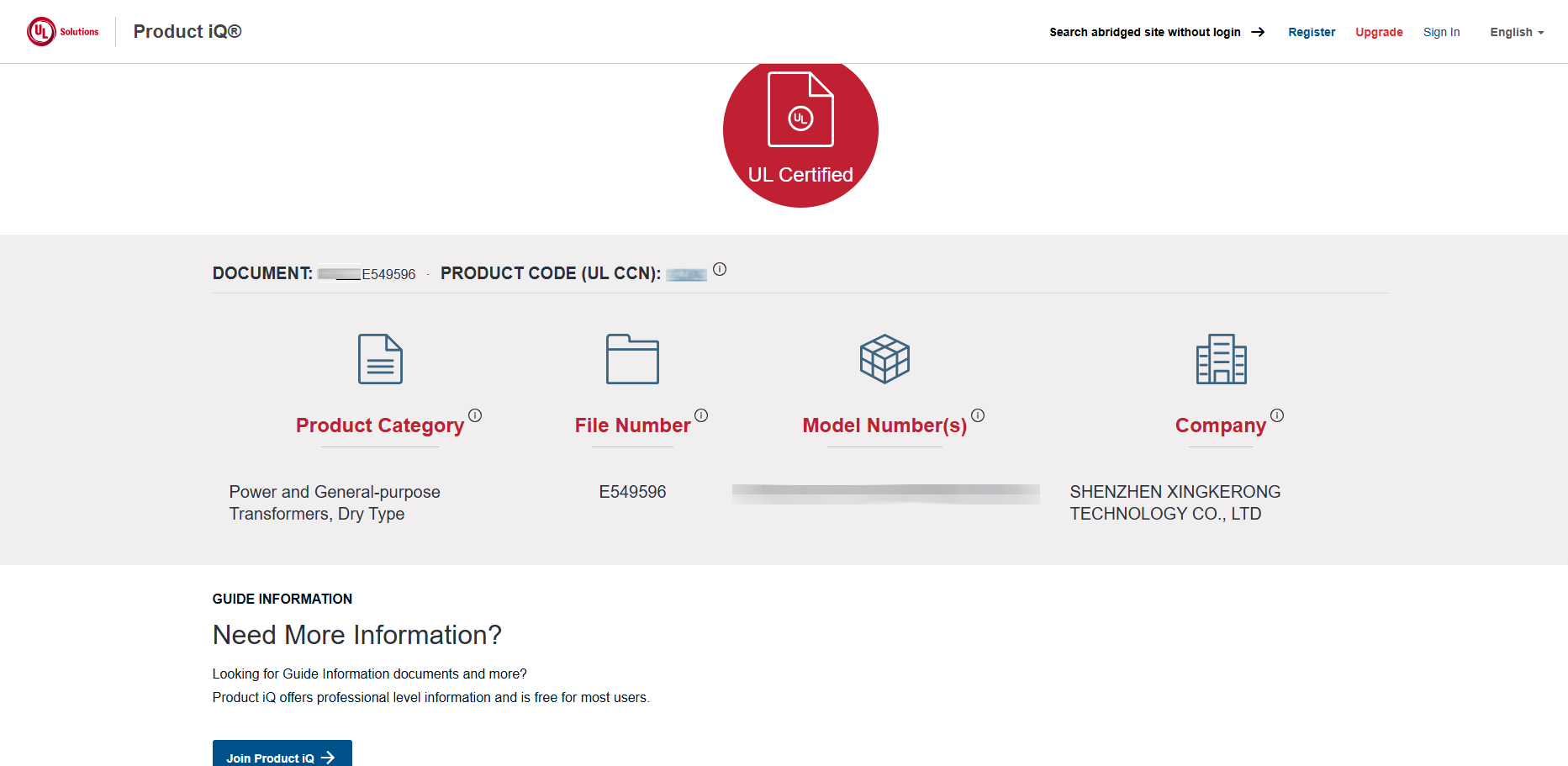
To satisfy these combined requirements, Xingkerong UL/cUL-listed dry-type isolation transformers cover ratings from 100 VA to 3,000 kVA. Under File Number E549596, listings cover UL 5085-1/5085-2, UL 1561 and UL 1562. K4/K7/K13/K20 harmonic factor ratings and 200% neutral capacity configurations are available, specifically addressing overheating and neutral overload risks induced by non-linear loads. These transformers adopt 100% copper windings and a UL 1446 recognized Class H (180°C) insulation system. Combined with VPI vacuum pressure impregnation and electrostatic shielding structure, they suppress common-mode and N-PE interference entering load circuits, protecting sensitive IT loads in data centers. The supplied UL documentation package, listing verification screenshots, nameplate checklists and factory test reports help resolve acceptance uncertainties at the procurement stage.
In terms of uninterruptible power supply, Xingkerong online frequency UPS units have built-in isolation transformers, featuring zero transfer between mains and battery power, voltage regulation, waveform purification and harmonic suppression. They can be delivered together with UL-listed isolation transformers to form a complete power distribution chain complying with North American data center requirements. For cabinet and edge node scenarios, rack-mounted online UPS units range from 1 to 10 kVA, fitting distributed deployment with limited space.
Selection Recommendations
In general, maintenance-free, high-precision contactless smart voltage stabilizers with three-phase balance are preferred for medical imaging equipment. Data center power matching needs to consider the harmonic adaptability of isolation transformers and the zero-transfer capability of UPS, while paying attention to UL listing requirements for North American projects. Supported by in-house independent R&D and manufacturing, Xingkerong covers the full workflow including electromagnetic design, structural design, production processes and factory testing. Standard products can be delivered in 7–10 working days , providing traceable and verifiable power distribution solutions for medical and data center users.